


The Unprompted Signal, issue 6.
Moves: cost to acquire, conversion, team hours.
Here’s an unpopular opinion: a lot of marketing teams switching on AI agents right now are wasting their money.
That’s not because agents don’t work. It’s because they’re putting them in the wrong place. They pick the job with the flashiest demo, the one that looks great in a board deck, and then wonder why cost to acquire hasn’t budged.
The teams seeing real numbers move are doing something far less exciting. They put their first agent on a job that already has a number attached, clean inputs and one person who owns it.
Your first agent should be a bit boring. If it isn’t, you’ve probably picked the wrong one.
This week’s signal
On October 27, Sprinklr opened a beta of six marketing agents at once: ideation, creative, campaign execution, compliance, community and budget optimization (Sprinklr). People keep control of strategy, approvals and brand decisions. There’s no pricing, no results and no launch date yet.
The same day, a Smartly survey of 500 marketers in the United States and the United Kingdom found that 77% are comfortable with AI in advertising when a human has the final say (Agile Brand Guide, October 28). That’s Smartly’s own research, and Smartly sells advertising technology.
Let’s be honest about what a six-agent bundle really is: six new workflows to check, staff and trust, all landing on a team that’s already stretched. Getting an agent is no longer the hard part. Choosing the first one is, and a bundle quietly makes that choice for you.
What it means for you: don’t let a vendor’s product menu decide where your first agent goes. Switch on the one closest to a number you already track, prove it there, and only then add the next.
Two questions, one map
Every job you might hand to an AI agent gets judged on two things.
Value. How close does this job sit to a number you already report, and how much time or money runs through it?
Readiness. Are the inputs clean, can you say what good looks like, and is a mistake cheap to fix?
Put every candidate job on those two axes and four groups fall out.
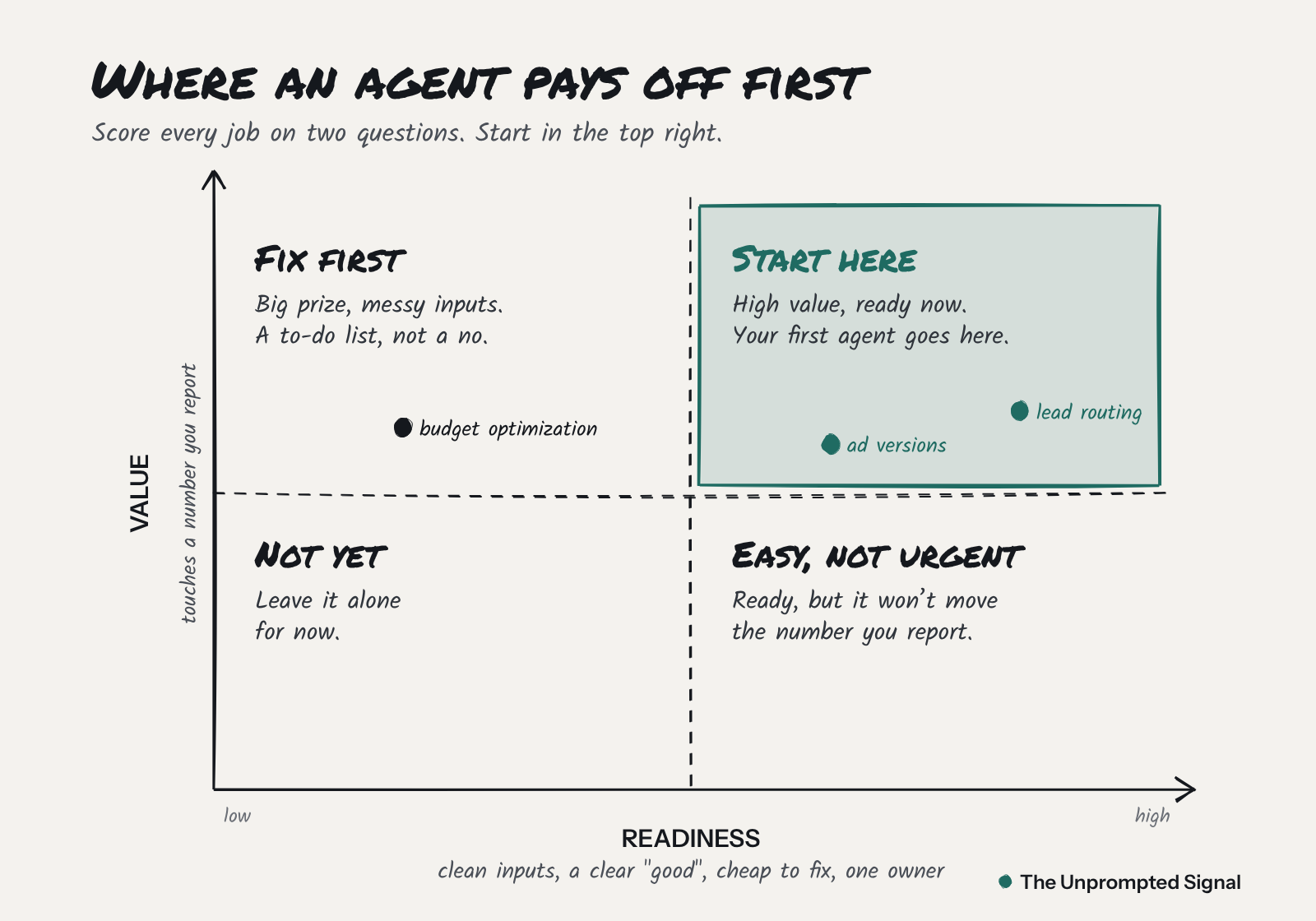
Start here (high value, high readiness). The job is tied to a number and the inputs are ready. Think lead routing (sending each new lead to the right person or next step), or turning one approved ad into every size and version each channel needs.
Fix first (high value, low readiness). The payoff is big, but the inputs are messy. Budget optimization often lands here: the prize is real, but if your tracking is shaky, the agent will simply optimize the wrong thing faster.
Easy, not urgent (low value, high readiness). It’s fine to try, but it won’t move the number your boss asks about.
Not yet (low value, low readiness). Leave it alone for now.
Here’s the part some teams won’t love: the job you were most excited about probably sits in Fix first, because your data isn’t ready for it yet. That’s not a reason to skip it. It’s a to-do list for making it ready.
How to place each job
Ask seven yes or no questions, and give the job a point for every yes. It takes a few minutes per job, and it’s a lot more honest than a gut call.
Value (up to 3 points)
Does it touch a number you already report, like cost to acquire or conversion?
Does it take up more than a few hours a week, or real budget?
Does it happen at least once a week?
Readiness (up to 4 points)
Are the inputs clean and in one place?
Can you write down what good looks like in one sentence?
If the agent gets it wrong, can you catch it and fix it within a day?
Is there one named person who owns the job today?
A job that scores at least two on value and at least three on readiness belongs in Start here. Your first agent goes to the highest scorer in that group.
Where this goes wrong
Letting the vendor pick. A platform that ships six agents would love you to switch on all six. That’s their growth plan, not yours. Decide where the first agent goes before you sit through a single demo.
Picking for the demo. The flashiest agent is rarely the one closest to your numbers. If you can’t name the metric it moves, it isn’t your first agent.
Skipping the trust step. An agent nobody trusts gets ignored. In a StackAdapt survey of 500 marketers this summer, only 6% said they almost always act on the AI recommendations inside their advertising platforms (Relevant Audience; StackAdapt’s own research). The recommendations were there. The trust wasn’t. Readiness is how you earn it.
Adding the second agent too soon. This is where restraint pays for itself. One agent with a clear brief and a number to hit will teach you more than six running at once. Hold the next one until the first has moved something.
Try this: map ten jobs, pick one
The outcome: your first agent goes where it can lower cost to acquire, lift conversion or hand hours back to your team.
How to get there:
List ten jobs. Write down the repeating work your team does every week. Don’t filter yet.
Score each one. Run the seven questions above, and be strict: “sort of” counts as a no.
Plot them. Put value on the vertical axis and readiness on the horizontal one. A whiteboard is fine.
Pick one from Start here. Choose the highest scorer and write its brief in one line: “This agent exists to move [the number] from X to Y.”
Keep a person on the final yes. For the first 30 days, a human approves anything that goes out.
The test: run that one agent for 30 days and leave everything else as it is.
Watch this number: track the metric in your one-line brief, plus the hours per week your team spends on that job.
What good looks like: the number moves the right way, the hours go down, and nobody asks you to switch it off.
The close
The teams that win with agents won’t be the ones with the most of them switched on. They’ll be the ones that picked the right first job, proved it worked and built from there.
Start with ten jobs, ask seven questions and switch on one agent. If that sounds too slow, that’s exactly why it works.
Over to you: which job landed in your Start here box, and which one were you secretly hoping would? Run the test and tell me what moved, in the comments.